Journal of Biology and Medicine
The Preliminary Study on the Effect of Mongolian Milkvetch Root Extract Containing Cycloastragenol on Telomere Length in Myanmar People
1Research & Development Department, FAME Pharmaceuticals Industry Co., Ltd, Yangon, Myanmar
2Research Manager, Research & Development Department, FAME Pharmaceuticals Industry Co., Ltd; Myanmar
3R&D Director, Research & Development Department, FAME Pharmaceuticals Industry Co., Ltd, Yangon, Myanmar
Author and article information
Aye Aye, Research Manager, Research & Development Department, FAME Pharmaceuticals Industry Co., Ltd; Myanmar, E-mail: [email protected]
Cite this as
Lwin KM, et al. The Preliminary Study on the Effect of Mongolian Milkvetch Root Extract Containing Cycloastragenol on Telomere Length in Myanmar People. J Biol Med . 2026; 10(1): 9-13. Available from: 10.17352/jbm.000050
Copyright License
© 2026 Lwin KM, et al. This is an open-access article distributed under the terms of the Creative Commons Attribution License, which permits unrestricted use, distribution, and reproduction in any medium, provided the original author and source are credited.Telomere shortening is a primary hallmark of biological aging and is influenced by factors such as nutritional status and psychological stress. The effects of RejuMax, a nutritional supplement containing cycloastragenol derived from Mongolian milkvetch root extract, on telomere length in the Myanmar population had not been previously investigated. This study evaluated the impact of RejuMax supplementation on telomere length in healthy middle-aged adults in Myanmar. A total of 10 participants (mean age: 50.1 ± 10.3 years) were enrolled, including four men (mean age: 51.5 ± 13.8 years) and six women (mean age: 49.1 ± 8.5 years). Participants received RejuMax supplementation for six months, followed by a six-month washout period. Average telomere length (TL) was measured at baseline, after six months of supplementation, and after the washout period using the qPCR method. RejuMax supplementation was well tolerated, and no adverse events were reported during the study. A statistically significant increase in TL was observed following the six-month supplementation period (p < 0.05). However, telomere length declined toward baseline values during the subsequent washout phase, suggesting that the observed effects may not be sustained in the absence of continued supplementation.
TEL: Telomere; TL: Average Telomere Length; SCR: Single-Copy Reference
Introduction
Telomeres are repetitive nucleotide sequences (TTAGGG) located at the ends of eukaryotic chromosomes that safeguard genomic stability during cell division. Telomeres protect the integrity of information-carrying DNA by serving as caps on the terminal portions of chromosomes [1]. Telomere length decreases with age, contributing to cellular senescence [2,3]. With each replication cycle, telomeres progressively shorten, making cells increasingly susceptible to chronic diseases. [4].
Telomere length generally shortens with each cell division until one or more telomeres become critically short, triggering cell senescence, loss of normal cell function, genomic instability, and possibly cell death or tumor initiation [5]. Telomerase is the only enzyme that can replicate and lengthen telomeres. When telomerase is inactive, telomeres shorten with each cell cycle until they reach a critically low length. At this point, cells can no longer divide and undergo senescence or apoptosis. The enzyme that synthesizes telomeric DNA can slow or even reverse telomere shortening in normal human cells in culture and contribute to slowing or reversing degenerative age-related diseases in animals [6].
Natural compounds derived from Astragalus mongholicus (Mongolian milkvetch), specifically saponins cycloastragenol and astragaloside IV, have demonstrated significant telomerase-activating potential in in vitro and in vivo preclinical studies [7,8]. These compounds possess a wide variety of pharmacological activities, such as anti-aging, anti-inflammatory, antioxidant, anti-fibrotic, anti-microbial, anti-viral, hepatoprotective, and endothelial protective properties. Moreover, they enhance telomere maintenance, improve immune function, and mitigate age-related physiological decline [9,10].Natural product telomerase activators could play a role in the treatment of aging-related diseases in humans [11-14]. Zhang et al. demonstrated that cycloastragenol is a potentially novel senolytic agent with in vivo activity that can be used to treat age-related diseases. [15]. Furthermore, animal studies strongly support the link between telomere length and lifespan, suggesting that mice with longer telomeres exhibit increased longevity and improved health [16]. However, despite these promising laboratory results, evidence from human clinical trials remains sparse and inconclusive.
Aging research is of particular importance in Myanmar, where the average life expectancy is approximately 67 years, considerably lower than the global average (WHO, 2021). This disparity underscores the urgent need to better understand the biological mechanisms underlying premature aging, age-related morbidity, and reduced longevity within the local population. Identifying accessible and evidence-based nutritional interventions that promote cellular health and longevity represents both a scientific imperative and a public health priority. Such approaches have the potential to enhance health span, reduce the burden of age-associated diseases, and improve overall quality of life among the people of Myanmar.
This knowledge gap highlights the need for rigorously designed clinical studies to determine whether cycloastragenol can meaningfully modulate telomere length in humans. Therefore, the present study aimed to evaluate changes in telomere length among healthy middle-aged adults following six months of supplementation with RejuMax, a cycloastragenol-containing extract derived from Mongolian milkvetch root.
Materials and methods
Participant selection and study population
Fasting blood samples were collected from 10 healthy volunteers (4 males and 6 females; mean age: 50.7 years, range: 39–65 years) recruited from the workforce at FAME Pharmaceuticals Industry Co., Ltd. Written informed consent was obtained from all participants before study inclusion. Eligibility was based on meeting the health standards defined in the factory’s annual medical check-up criteria.
Comprehensive baseline data including demographics, body mass index (BMI), smoking status, alcohol consumption, physical activity levels, medical history, and concurrent medication use were collected via structured questionnaires and clinical examinations before enrollment. All participants were non-smokers, had no history of chronic metabolic diseases, and were not taking any medications known to interfere with the study outcomes.
Materials (RejuMax product)
The telomerase activator evaluated in this study was RejuMax, a proprietary formulation comprising cycloastragenol-standardized Mongolian milkvetch root extract and chitosan powder, manufactured by FAME Pharmaceuticals Industry Co., Ltd. (Yangon, Myanmar). Each oral capsule contains 100 mg of Mongolian milkvetch root extract (standardized to 10 mg cycloastragenol) and 50 mg of chitosan powder as an excipient.
In this six-month preliminary clinical study involving healthy volunteers, dosing was age-stratified as follows: participants aged 35–59 years received one capsule daily in the morning (10 mg cycloastragenol/day), while participants aged 60–65 years received two capsules daily (one morning, one evening; 20 mg cycloastragenol/day).
RejuMax is a registered, commercially available health supplement with an established safety profile and no known toxicity. The study dosage (1–2 capsules daily) was selected in accordance with the manufacturer’s safety guidelines and published clinical literature on cycloastragenol and Astragalus-derived formulations (e.g., TA-65), which demonstrate biological activity and safety within daily cycloastragenol dosage ranges of 5 to 20 mg.
DNA isolation
DNA was extracted from whole blood using the innuPREP Blood DNA Mini Kit – IPC16 (IST Innuscreen GmbH, Berlin, Germany) according to the manufacturer’s protocol. The innovative liquid handling-based instrument InnuPure C16 touch (Analytik Jena, Germany) was used for automated nucleic acid isolation. A ScanDrop2 Nano-volume spectrophotometer (Analytik Jena, Germany) was used to determine the purity and quantify the DNA concentration.
Measurement of absolute telomere length by qPCR
The average telomere length was determined using the Absolute Human Telomere Length Quantification qPCR Assay Kit (ScienCell, #8918). The kit includes a telomere (TEL) primer set that amplifies telomere sequences, single-copy reference (SCR) primers for data normalization, and reference genomic DNA with a known telomere length as a reference for calculating the telomere length of target samples. For qPCR, 5 ng/µL of genomic DNA was combined with the TEL or SRC primers, 2 μl from the stock solution, 10 μl of 2X GoldNStart TaqGreen qPCR master mix, and nuclease-free water to a final volume of 20 μl. Each sample was prepared in triplicate in a 96-well plate and cycled on a qTower3G touch (Analytik Jena, Germany). The cycling steps included initial denaturation at 95 °C for 10 min, followed by 32 cycles of denaturation at 95 °C for 20 s, annealing at 52 °C for 20 s, and extension at 72 °C for 45 s. Melt curve analysis was performed at the end of the run.
To calculate the average telomere length, the ΔCq (TEL) and ΔCq (SCR) values were determined by subtracting the Cq values of the target sample from the Cq values of the reference sample for the TEL and SCR primers, respectively. ΔΔCq was calculated as ΔCq (TEL)–ΔCq (SCR). The fold change was assessed as 2−ΔΔCq. The total telomere length of the target sample per diploid cell was calculated using the following formula: reference sample telomere length (1.23 ± 0.09 Mb) × 2−ΔΔCq. As there are 92 chromosome ends in one diploid cell, the average telomere length on each chromosome end was obtained by dividing the total telomere length by 92.
Statistical analysis
Mean values and standard deviations were calculated for the ten participants. The results were analyzed using Excel 2026 and GraphPad Prism software (version 10.6.1; GraphPad Software, Inc., La Jolla, CA, USA). The TL of the participants was evaluated using Welch’s t-test to identify statistically significant differences. Statistical significance was set at p < 0.05.
Results
Compliance
Ten participants with a mean age of 50.1 ± 10.29 years were included. There were four males (mean age: 51.5 ± 13.8 years) and six females (mean age: 49.1 ± 8.5 years). All participants completed the 6-month supplementation and 6-month washout phases, with no adverse side effects reported.
Average telomere length before and after 6 months of RejuMax treatment
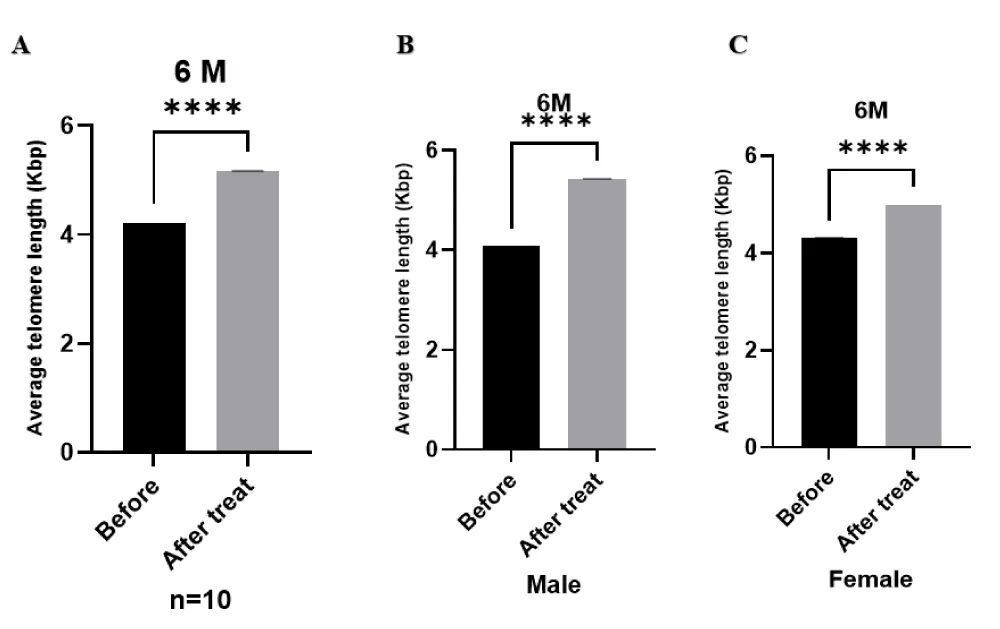
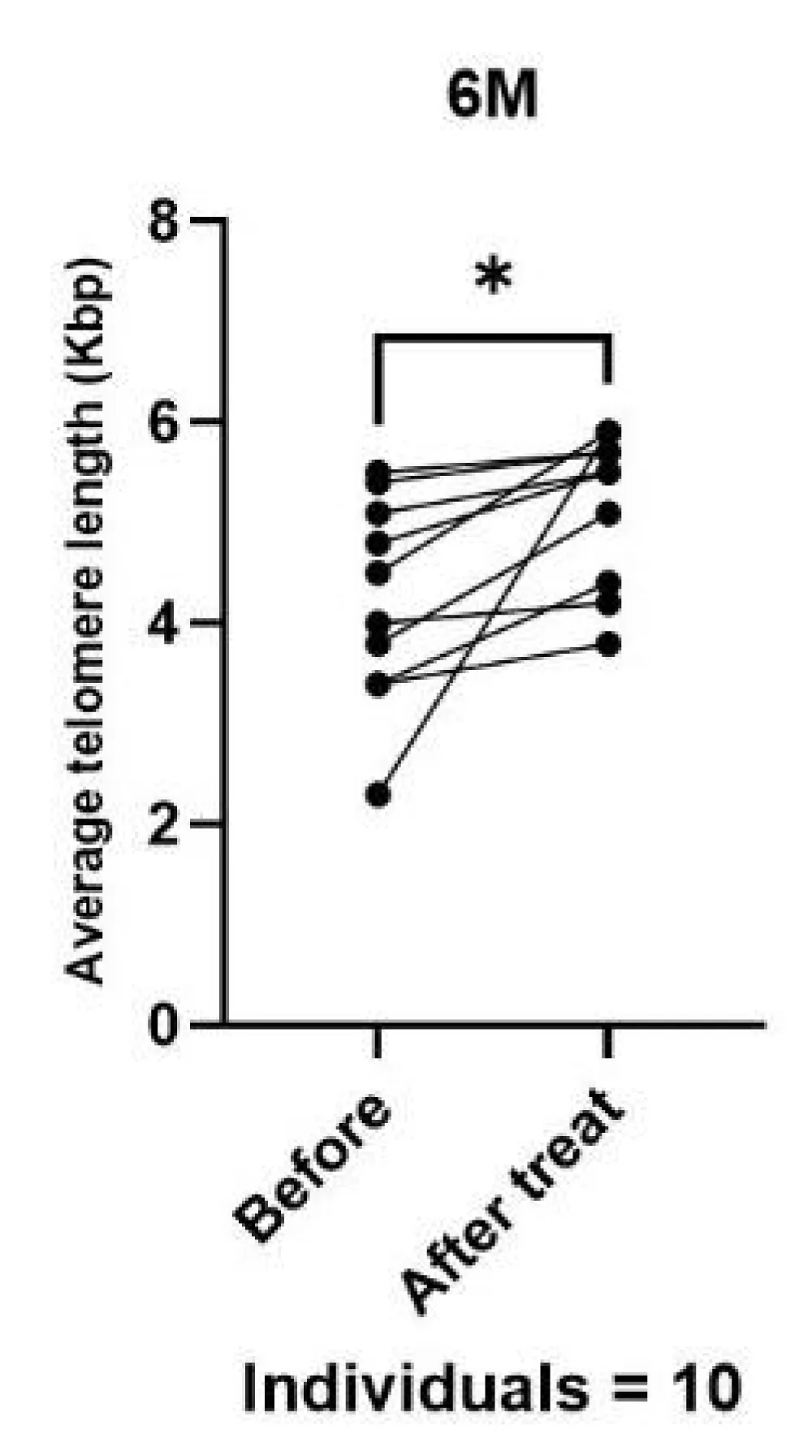
A paired comparison of telomere length before and after 6 months of RejuMax treatment (Figure 1) showed that the baseline average telomere length (TL) was 4.22 ± 1.03 kbp. Following six months of RejuMax supplementation, TL increased significantly to 5.17 ± 0.76 kbp (p <0.0001) across all 10 participants. Subgroup analysis confirmed consistent trends across sexes: males (n=4) showed an increase in TL from 4.08 ± 1.34 kbp to 5.43 ± 0.82 kbp (p <0.0001), while females (n=6) showed an increase in TL from 4.32 ± 0.89 kbp to 5.00 ± 0.75 kbp (p <0.0001). Individual analyses also demonstrated a significant increase in telomere length after treatment with RejuMax (p = 0.0315) (Figure 2).
Average telomere length during the 6-month washout period
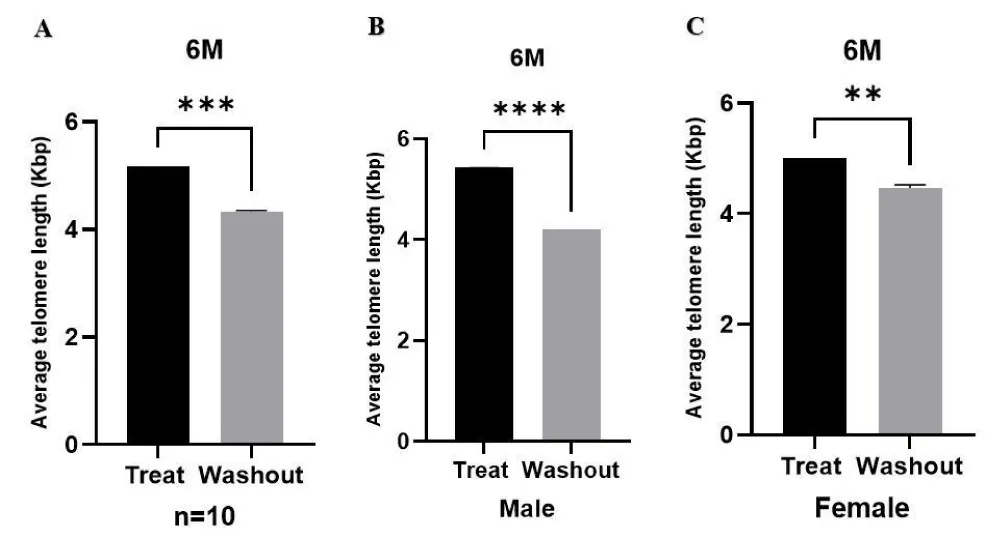
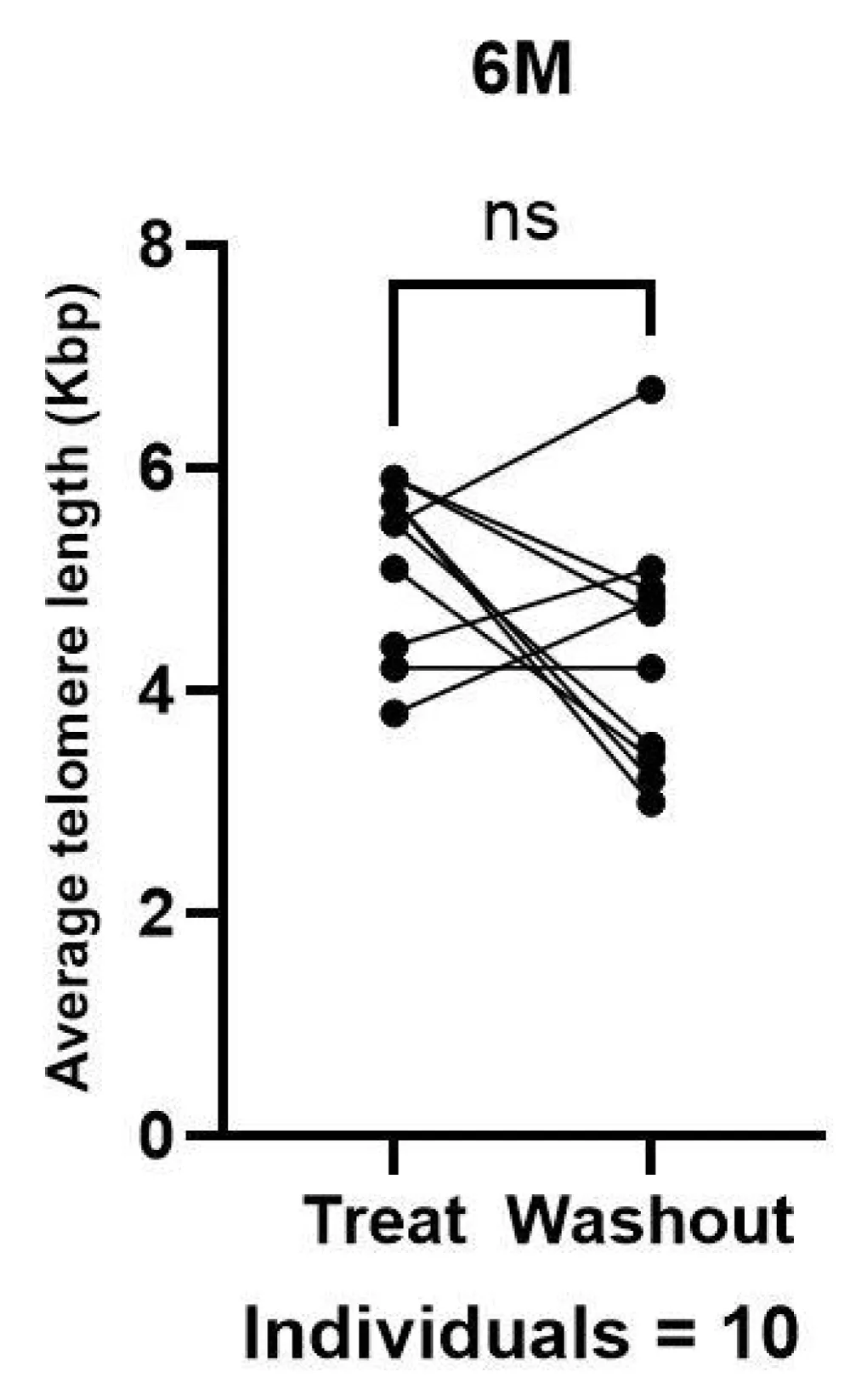
The average telomere length was re-evaluated in 10 participants during the 6-month washout period (Figure 3). The results showed a significant decrease in telomere length across all participants (4.35 ± 1.13 kbp, p = 0.0003). Subgroup analysis revealed similar reductions: males (n=4) showed a decrease to 4.20 ± 0.85 kbp (p <0.0001), and females (n=6) showed a decrease to 4.45 ± 1.35 kbp (p= 0.0039). However, individual changes during the washout phase were not statistically significant (p= 0.0759) (Figure 4). Notably, participants exhibiting high occupational stress experienced greater telomere attrition during this phase.
Discussion
The association between psychological stress and accelerated cellular aging is firmly established in the literature. In their pioneering work, Dr. Elissa Epel and Nobel laureate Dr. Elizabeth Blackburn demonstrated that both perceived and chronic stress are significantly associated with elevated oxidative stress, suppressed telomerase activity, and diminished telomere length [17]. Mechanistically, oxidative stress can directly damage telomeric DNA, thereby accelerating its attrition during cellular division [18].
Our findings align with prior evidence indicating that telomere dynamics are sensitive to psychological stress [19,20]. In this longitudinal pilot study of ten participants, individuals reporting higher stress levels exhibited greater telomere attrition. A reduction in telomere length was also observed during the six-month washout period following RejuMax supplementation in participants M1, M3, M4, F1, F2, and F5 (Table 1). Overall, telomere length did not differ significantly from baseline after the washout phase, suggesting that the observed effects may not be sustained without continued supplementation.
Extensive evidence indicates that lifestyle and environmental factors play key roles in regulating telomere length and telomerase activity [21,22]. Accordingly, identifying effective telomerase activators remains an important goal in the development of interventions targeting biological aging and telomere-associated disorders. In this study, we evaluated the effects of RejuMax, a cycloastragenol-containing formulation reported to induce telomerase activity in a healthy Myanmar population.
This study has several limitations. First, the small sample size (n = 10; 4 males, 6 females) limits statistical power, increases susceptibility to Type I errors, and precludes robust sex-stratified analyses or broader generalization. Second, the single-arm, open-label design lacked a parallel placebo control group. Consequently, observed telomere length changes cannot be attributed solely to RejuMax supplementation, as natural biological fluctuations, unmonitored lifestyle changes, qPCR measurement variability, and regression to the mean may have introduced bias. Although the decline in telomere length observed during the 6-month washout phase supports a reversible, supplement-dependent effect, randomized double-blind placebo-controlled trials with larger cohorts are required to confirm these exploratory findings.
Our results provide preliminary evidence that cycloastragenol supplementation may positively influence telomere dynamics in healthy middle-aged adults. The observed increase in telomere length after six months of supplementation suggests a potential role for RejuMax in attenuating age-related telomere attrition. These findings are consistent with those of Yu et al., who reported that cycloastragenol exhibits multiple pharmacological activities, including telomerase activation, telomere elongation, and anti-inflammatory, antioxidant, and antiviral effects [7].
In summary, RejuMax supplementation was associated with a significant increase in telomere length over six months, with values returning toward baseline following the washout period. These findings suggest that RejuMax may act as a natural modulator of telomere dynamics with potential implications for aging-related interventions; however, sustained effects appear to depend on continued use.
Conclusion
RejuMax supplementation was associated with a significant increase in telomere length in healthy middle-aged adults; however, this effect diminished following a six-month washout period. These findings suggest that cycloastragenol can modulate telomere dynamics, while psychological and occupational stress may influence the durability of these effects. As the first study of its kind in Myanmar, this work provides a preliminary foundation for larger, controlled trials evaluating telomere-targeted interventions for healthy aging.Acknowledgement
This study was supported by the Research and Development Department of FAME Pharmaceuticals Industry Co., Ltd. We express our deep gratitude to the ten participants who volunteered their time for the RejuMax study; their dedication and adherence to the study protocol were essential to the completion of this research.
- Schellnegger M, Hofmann E, Carnieletto M, Kamolz LP. Unlocking longevity: the role of telomeres and its targeting interventions. Front Aging. 2024;5:1339317. Available from: https://doi.org/10.3389/fragi.2024.1339317
- López-Otín C, Blasco MA, Partridge L, Serrano M, Kroemer G. The hallmarks of aging. Cell. 2013;153:1194-1217. Available from: https://doi.org/10.1016/j.cell.2013.05.039
- Huang X, Huang L, Lu J, Cheng L, Wu D, Li L, et al. The relationship between telomere length and aging-related diseases. Clin Exp Med. 2025;25:72. Available from: https://doi.org/10.1007/s10238-025-01608-z
- Tenchov R, Sasso JM, Wang X, Zhou QA. Aging hallmarks and progression and age-related diseases: a landscape view of research advancement. ACS Chem Neurosci. 2024;15:1-30. Available from: https://doi.org/10.1021/acschemneuro.3c00531
- Kutasi E, Chis A, Vintan MA, AlKhzouz C, Văduva DA, Cătană A, et al. Telomere biology, erosion, and age-related conditions: insights from Down syndrome and other telomere-associated disorders. Mol Neurobiol. 2025;62:16209-16228. Available from: https://doi.org/10.1007/s12035-025-05245-1
- Blackburn EH, Greider CW, Szostak JW. Telomeres and telomerase: the path from maize, Tetrahymena and yeast to human cancer and aging. Nat Med. 2006;12:1133-1138. Available from: https://doi.org/10.1038/nm1006-1133
- Borowicz KK, Jach ME. Astragalus membranaceus—can it delay cellular aging? Nutrients. 2025;17:1299. Available from: https://doi.org/10.3390/nu17081299
- Yu Y, Zhou L, Yang Y, Liu Y. Cycloastragenol: an exciting novel candidate for age associated diseases (Review). Exp Ther Med. 2018;16:2175-2182. Available from: https://doi.org/10.3892/etm.2018.6501
- He M, Wang K, Che H, Wang H, Yang K, Zhang G, et al. A comprehensive review of cycloastragenol: biological activity, mechanism of action and structural modifications. Eur J Med Chem Rep. 2022;5:100060.
- Hong H, Xiao J, Guo Q, Du J, Jiang Z, Lu S, et al. Cycloastragenol and Astragaloside IV activate telomerase and protect nucleus pulposus cells against high glucose-induced senescence and apoptosis. Exp Ther Med. 2021;22:1326. Available from: https://doi.org/10.3892/etm.2021.10761
- Salvador L, Singaravelu G, Harley CB, Flom P, Suram A, Raffaele JM. A natural product telomerase activator lengthens telomeres in humans: a randomized, double-blind, and placebo-controlled study. Rejuvenation Res. 2016;19:478-484. Available from: https://doi.org/10.1089/rej.2015.1793
- De Jaeger C, Kruiskamp S, Voronska E, Lamberti C, Baramki H, Beaudeux JL, et al. A natural Astragalus-based nutritional supplement lengthens telomeres in a middle-aged population: a randomized, double-blind, placebo-controlled study. Nutrients. 2024;16:2963. Available from: https://doi.org/10.3390/nu16172963
- Singaravelu G, Harley CB, Raffaele JM, Sudhakaran PS, Suram A. Double-blind, placebo-controlled, randomized clinical trial demonstrates telomerase activator TA-65 decreases immunosenescent CD8+CD28- T cells in humans. OBM Geriatr. 2021;5:1-26. Available from: https://www.lidsen.com/journals/geriatrics/geriatrics-05-02-168
- Tsoukalas D, Fragkiadaki P, Docea A, Alegakis A, Sarandi E, Thanasoula M, et al. Discovery of potent telomerase activators: unfolding new therapeutic and anti-aging perspectives. Mol Med Rep. 2019;20:3701-3708. Available from: https://doi.org/10.3892/mmr.2019.10614
- Zhang Y, Gao D, Yuan Y, Zheng R, Sun M, Jia S, et al. Cycloastragenol: a novel senolytic agent that induces senescent cell apoptosis and restores physical function in TBI-aged mice. Int J Mol Sci. 2023;24:6554. Available from: https://doi.org/10.3390/ijms24076554
- Muñoz-Lorente MA, Cano-Martín AC, Blasco MA. Mice with hyper-long telomeres show less metabolic aging and longer lifespans. Nat Commun. 2019;10:4723. Available from: https://www.nature.com/articles/s41467-019-12664-x
- Epel ES, Blackburn EH, Lin J, Dhabhar FS, Adler NE, Morrow JD, et al. Accelerated telomere shortening in response to life stress. Proc Natl Acad Sci U S A. 2004;101:17312-17315. Available from: https://doi.org/10.1073/pnas.0407162101
- von Zglinicki T. Oxidative stress shortens telomeres. Trends Biochem Sci. 2002;27:339-344. Available from: https://doi.org/10.1016/s0968-0004(02)02110-2
- Souza-Talarico JN, Chesak S, Elizalde N, Liu W, Moon C, Oberfrank NDCF, et al. Exploring the interplay of psychological and biological components of stress response and telomere length in the transition from middle age to late adulthood: a systematic review. Stress Health. 2024;40(4). Available from: https://doi.org/10.1002/smi.3389
- Francis M, Lindrose A, O’Connell S, Tristano RI, McGarvey C, Drury S. The interaction of socioeconomic stress and race on telomere length in children: a systematic review and meta-analysis. SSM Popul Health. 2023;22:101380. Available from: https://doi.org/10.1016/j.ssmph.2023.101380
- Bae CY, Kim IH, Kim SH, Chun H, Kim BS, Jeon MH. Effects of lifestyle on telomere length: a study on the Korean population. PLoS One. 2025;20. Available from: https://doi.org/10.1371/journal.pone.0325233
- Andreu-Sánchez S, Aubert G, Ripoll-Cladellas A, Henkelman S, Zhernakova DV, Sinha T, et al. Genetic, parental and lifestyle factors influence telomere length. Commun Biol. 2022;5:565. Available from: https://doi.org/10.1038/s42003-022-03521-7



 Save to Mendeley
Article Alerts
Subscribe to our articles alerts and stay tuned.
 This work is licensed under a Creative Commons Attribution 4.0 International License.