Interpretation of Deletion of Y-allele in Some Cases
Forensic Science Laboratory, Home Department, GNCT OF Delhi, Rohini, Delhi-110085, India
Author and article information
Cite this as
Kumari A, et al. Interpretation of Deletion of Y-allele in Some Cases. Forensic Sci Today. 2026; 12(1): 4-6. Available from: 10.17352/fst.000028
Copyright License
© 2026 Kumari A, et al. This is an open-access article distributed under the terms of the Creative Commons Attribution License, which permits unrestricted use, distribution, and reproduction in any medium, provided the original author and source are credited.DNA profiling plays a crucial role in sexual assault cases, murder and other missing identity cases because individuals can be identified through DNA profiling in unidentified dead body or mass disaster cases. It was observed that a DNA profile shows a Y deletion on amelogenin in some cases due to a mutation in the gene. A male DNA sample may sometimes be incorrectly represented as female if there is a deletion in a specific region of y-chromosome regions it expresses no alleles on some of the markers of Y STR. Sometimes it shows no peaks, double peaks or 4 peaks in Y STR markers. DNA quantification using specialised quantification kits like Quantifiler Trio can play an important role in sex determination, as this kit assesses both total human DNA and male-specific DNA targets. This issue can be addressed by forensic scientists through the use of multiple Y-chromosome markers (more than three) and determination due to Y-chromosome deletions. Further, there are deletion have been observed on # markers of Y-STR kits.
Humans have 23 pairs of chromosomes. The first 22 pairs are called autosomes (autosomal chromosomes) and are the same in both males and females. The 23rd pair consists of the sex chromosomes, which differ between males (XY) and females (XX). Human eggs contain only an X chromosome since females possess two X chromosomes (XX) and produce eggs carrying one X chromosome each during meiosis. Males have one X or one Y chromosome (XY), so their sperm carry either an X chromosome or a Y chromosome. If a sperm carrying an X chromosome fertilises an egg, the resulting zygote will have XX chromosomes and will develop as a female. On the other hand, if the fertilising sperm carries a Y chromosome, the zygote will be XY and will develop as a male. In summary, the gender of the child is determined by whether the fertilising sperm carries an X chromosome or a Y chromosome.
The Y chromosome is the third smallest human chromosome, being only slightly larger than chromosome 21 (47 Mb) and chromosome 22(49Mb). The Y chromosome contains many repetitive DNA sequences and duplicated regions, both within the Y chromosome and in areas that share homology with the X chromosome. This reflects the fact that the Y chromosome has extensive internal duplications (palindromic and ampliconic sequences) as well as regions that are similar to corresponding regions on the X chromosome [1]. A deletion is a genetic mutation in which one or more nucleotides are removed from a segment of DNA, ranging from a single nucleotide to large chromosomal regions. A deletion can involve the loss of one or more nucleotides, ranging from single nucleotides to a large DNA sequence or even an entire gene. Y chromosome microdeletions refer to the absence of small DNA segments or gene (s) from the euchromatic(functionally active) region of the Y chromosome. Currently, Y chromosome microdeletions (YCMs) are recognised as the most common structural chromosomal abnormalities associated with spermatogenic failure, occurring in about 15-20 % of men with idiopathic azoospermia and with reported frequencies ranging from 1% to 58% in different study populations. [2]. Y chromosome microdeletions are among the most common genetic causes of male infertility and occur in about 10-15 % of men with azoospermia or severe oligospermia. Because Y chromosome microdeletions are too small to be visualised by conventional cytogenetic techniques such as karyotyping, they are typically detected using polymerase chain reaction (PCR) based methods [3]. The human Y chromosome contains genetic material responsible for normal testis development and spermatogenesi [4].
Material and methodology
The samples were received in this laboratory for foetal identification in connection with a case registered under Section 94 BNS, relating to the concealment of birth by secretly burying or disposing of the dead body of a child. The sex of the fetus was determined using DNA analysis [5]. The disposal of a fetus may be associated with various factors, such as fatal abnormalities, inability to care for the child, socioeconomic circumstances, or gender-based discrimination [6]. The matter is reported to the police, and on the request of the police, an autopsy of the dead fetus is done. The samples are collected by the autopsy surgeon and given to the police for DNA profiling. These samples are preserved in normal saline and stored at -20ºc to maintain their integrity for further examination. The automated method was used for this study. We have taken more than 90s plus sample for DNA profiling. Following this procedure, we use small pieces of bone/tissues/blood in cases as per case history. In the case of bone, first these were cleaned with water to remove the fleshy material and then washed with alcohol two to three times; after that put in an oven or an instrument where it is dried at 45 ºC. After that bone is broken and bone marrow is used for DNA extraction it further put into tube of 1.5ml micro centrifuge. In the case of blood, we directly used blood; in cases of tissues, first it is washed with molecular grade water, then a small portion is used, and then Case work extraction buffer 386µl, Proteinase K 20µl, thioglycerol 20 µl and 20 µl DTT were added to the samples, which are present in the Maxwell DNA IQ case kit. The samples were vortexes kept at 56ºC for 3 hours or 37 ºC overnight for digestion of cells. After span of overnight, the samples were vortexed for 1 minute, and the extract was transferred to new MCT tubes. Then, 200 µl lysis buffer was added to the extracted sample. After vortexes of samples, they were poured into 1 well of the cartridges of Maxwell kits. Also, make elution tubes by pouring 30 µl elution buffer, which was also present in Maxwell kits, and after this, put plungers into each of the 8 wells of the cartridges and put the tray into the Maxwell instrument. Then, run the protocol of the Maxwell DNA IQ case extraction procedure. This process was completed within 22 min, and we have the isolated DNA. To preserve the samples for a long period, we kept them at -20 ºC and stored them in a short run at a 4 ºC refrigerator. Now, the samples were ready for quantification by real-time PCR.
Real-time pcr
PCR was done using the QuantiFiler Trio kit from Applied Biosystems, following the manufacturer’s instructions. The total reaction volume was 25 microliters, which included the reaction mix, primers, and the DNA samples as specified. Standard samples were used along with the actual samples to check how well the result worked. These results helped us find out if there was human male DNA in the samples, but this method is not useful for sodomy cases because usually both the victim and the accused are men. The samples were diluted based on the values from RT-PCR, and approximately 1 nanogram per microliter of DNA was used for DNA profiling. The samples were ready for PCR amplification by using the Powerplex F6C kit or GlobalFiler IQC kit. This kit contains 27 markers, including three markers of the Y chromosome, and helps in the determination of the gender of the sample. A 1 µl sample was added to the mix with Hi-Di formamide 24.5µl and 0.5 µl LIZ/WEN. Electrophoresis was carried out using the Genetic Analyser instrument from Applied Biosystems model 3500XL. The samples were run on the instrument, and the specific alleles were identified using the Gene Mapper ID-X 1.4 Software.
Result
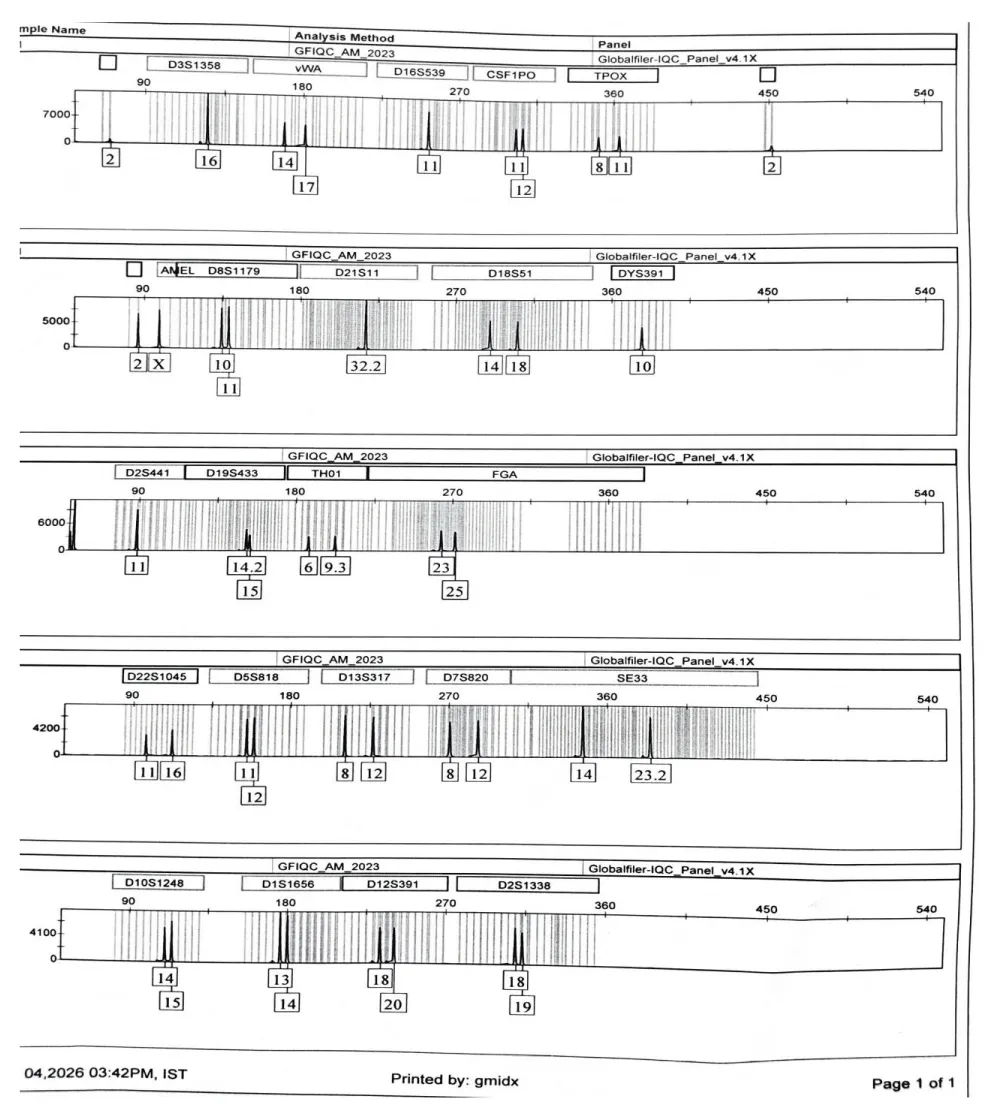
The Quantifiler Trio DNA Quantification kit is used to obtain a quantitative and qualitative assessment of total human and human male DNA in a single, highly sensitive real-time PCR reaction [7]. The Quantifiler Trio Kit uses multiple–copy target loci for improved detection sensitivity. There are three human–specific target loci: Small Autosomal, Large Autosomal, and a Y–chromosome target. Each consists of multiple copies dispersed on various autosomal chromosomes. In the case of the Global Filer IQC Kit PCR, which has two Y chromosome markers, and in the case of PowerPlex Fusion 6C, which has four male markers that play a crucial role in identifying male DNA. But in the case of Y STR deletion, Y amelogenin is absent in both kits and alleles on markers DYS576 and DYS570 were absent in the PowerPlex Fusion 6C kit. But in the marker DYS391, the Y allele is present in the Globalfiler IQC kit (Table 1).
Discussion
In the Promega 21 or Identifiler 16 markers kit, a male sample is misinterpreted as female due to deletion of the Y allele in autosomal STR. Y-23 kit can be used where only one marker, amelogenin, is present for sex determination. In Y-deletion cases, it was observed that 3-4 markers are generally absent in the Y STR Kit. RT PCR plays an important role in the determination of sex. It was observed that there is a deletion of the Y allele in amelogenin. We had also observed that in some cases, marker DYS385 has multiple peaks (Figuer 1).
Source of funding
This work was not funded by any funding organisation. All the samples were analysed in the Forensic Science Laboratory, Rohini, Delhi.
- Kumar N. Deletion of Y-allele in autosomal STR and role of STR. Norcal Publication; 2019. Available from: https://doi.org/10.15406/ijmboa.2019.04.00100
- Yadav B. Y chromosome microdeletion: clinical and forensic implications. Indian J Health Sci Care. 2015. Available from: https://doi.org/10.5958/2394-2800.2015.00011.5
- Viswambharan N, R Suganthi, A M Simon, S Manonayaki. Male infertility: polymerase chain reaction-based deletion mapping of genes on the human chromosome. National Library of Medicine. 2007. Available from: https://pubmed.ncbi.nlm.nih.gov/18043844/
- Witherspoon L, Dergham A, Flannigan R. Y-microdeletion: review of the genetic basis for this common cause of male infertility. Transl Androl Urol. 2021. Available from: https://doi.org/10.21037/tau-19-599
- Seerat. Deletion of Y allele in a fetus. J Punjab Acad Forensic Med Toxicol. 2022.
- Butler JM. Forensic DNA typing: biology, technology, and genetics of STR markers. 2nd ed. Boca Raton (FL): CRC Press; 2005. Available from: https://books.google.co.in/books/about/Forensic_DNA_Typing.html?id=gwDyBq2xLjIC
- Li R. Sex chromosome haplotyping and gender identification. Amsterdam: Elsevier Academic Press; 2015.



 Save to Mendeley
Article Alerts
Subscribe to our articles alerts and stay tuned.
 This work is licensed under a Creative Commons Attribution 4.0 International License.