Semen Detection and its DNA Profiling from the Menstruating Rape Survivor
Forensic Science Laboratory, Home Department, GNCT OF Delhi, Rohini, Delhi-110085, India
Author and article information
Cite this as
Seerat, et al. Semen Detection and its DNA Profiling from the Menstruating Rape Survivor. Forensic Sci Today. 2026; 12(1): 1-3. Available from: 10.17352/fst.000027
Copyright License
© 2026 Seerat, et al. This is an open-access article distributed under the terms of the Creative Commons Attribution License, which permits unrestricted use, distribution, and reproduction in any medium, provided the original author and source are credited.It has been generally observed that a survivor is raped when she is not menstruating. In some of the cases, the survivor is raped during the period of menstruation. The alkaline nature of semen, having pH 7.2–8.0 is help to neutralize acidic nature of the vagina. Samples taken, such as vaginal swabs and washing from the vagina, lead to sperm detection and may help to get the DNA profiling from such dead sperm stuck to the walls of the vagina, but in the case of a menstruating victim, it is difficult to identify the sperm and get the DNA of the perpetrator due to a high amount of menstrual blood. This study suggests that the DNA profile can be generated from the vaginal swabs of a victim in the case of a menstruating victim even after 2-3 days.
There are different factors, such as enzymatic activity and chemical processes, which result in the degradation of DNA. Several forensic samples are degraded due to moisture and other environmental factors. Blood, semen, and foetal tissues need proper preservation for complete DNA profiling. Exposing blood to above 37ºC results in poor yielding of DNA, as heat accelerates hydrolysis of DNA. Menstruation is the periodic discharge of blood, which eliminates the lining of the endometrium from the uterus of women. Bleeding lasts for about 3-7 days, and there is a loss of 30 ml of blood. Cells become dead due to over exposure of temperature. Menstrual blood contains high-quality DNA from endometrial cells, immune cells and vaginal secretions. Vagina is acidic in nature, and the pH level is 3.8 to 4.5; however, blood has a higher pH level, and the pH level returns to normal after menstruation is over. A high pH may increase the risk of bacterial infection of the vagina. The acidic nature of the vagina is not supportive for semen, leading to rapid immobilisation and death of spermatozoa. Menstrual blood has a pH of 7.4, equal to the pH of blood, which leads to the elimination of sperm from the vagina. Cervical mucus is more basic around ovulation and may help to preserve semen for more than 5 days. Detection of semen and DNA profiling in such cases helps in determining the sexual assault. Throughout the reproductive lifespan, women typically undergo over 400 cycles of endometrial regeneration, differentiation and shedding [1]. Menstrual blood is used to determine the origin of stains at the crime scene, whether the sexual assault happened or not. DNA analysis of the sample reveals whether the stain originated from the victim or suspect. Stains present at the crime scene usually contain semen and vaginal secretions [2]. It is necessary to differentiate between normal blood and menstrual blood in the investigation of sexual assault, although damp blood may be the reason for degradation. Detection of semen in menstrual blood is a tedious process, as a high amount of blood hides the semen. In sexual assault with menstruating victims and delay in medical examination, there are higher chances of semen draining with menstrual blood. Menstrual blood offers a non-invasive sampling method for identifying biomarkers in endometriosis [3]. Many victims are ashamed of reporting the incidents, and this will lead to a delay in the medical examination of the victim. There are higher chances of semen detection from the washing of the vagina, as washing provides the dead sperm stuck to the walls of the vagina. The medical officer needs to collect important samples like inner wear, body swab, vaginal swab, rectal swab, etc which help in the detection of semen in the body of the victim [4]. Higher amount of blood masks the spermatozoa in menstrual blood. This is always questioned by the defence or the prosecution: how long sperm can survive in the vagina or cervix. Studies suggest that semen may be detected up to 5 days. There are different opinions but no accurate finding, as it depends on the condition of the survivor, age and hygiene condition of the survivor. We have done several cases in which we have analysed the semen detection and DNA profiling from menstrual blood. There are other options available for detection of semen and DNA profiling.
Menstrual blood contains fragments of shed endometrial tissue comprising epithelial, stromal, immune cells, blood cells, clots, cervical, vaginal mucus and secreted factors including proteins, immune cells and extracellular matrix debris [5]. For example, in one case, the victim was raped by her brother-in-law during the second day of menstruation. The victim’s medical examination was done on the same day. Samples were collected from the body of the victim, such as breast swab, vaginal swab, cervical mucus collection swab, washing from vagina, rectal swab, etc. In such cases, differential extraction should be used, as the amount of cells in either vaginal secretion or menstrual blood may hide the quantity of male DNA by the excess amount of female cells compared to male cells. The amount of female cells may be more than 20 times the male fraction in autosomal STR profiles. In such cases, Y-STR profiling may be done, or some of the sample may be used for differential DNA extraction to get the male DNA profiling from such samples. The perforation in the hymen may detain the sperm in the vaginal region, as this perforation stops the flow of sperm from the vagina. The cervix may also be the region where sperm can be detected. In this case, a high amount of blood creates a problem in detecting spermatozoa in menstrual blood. Differential extraction is used in sexual assault cases that contain a mixture of male and female DNA. Samples are collected by a doctor within 20-30 days, and they are received in the laboratory for analysis of samples, which is preserved at 4 ºc.
Material and methodology
The samples were received in this laboratory for identification of semen and DNA profiling. More than 20 cases of sexual assault were examined. In each case, more than 30 samples were analysed, and overall 600 samples were carried forward for the procedure of DNA profiling. The samples were preserved at -20ºc. The samples were first analysed for semen identification of samples. Qiagen Investigator-based DNA identification kit was used for DNA extraction of the samples.
Samples are taken in micro centrifuge tube. We added 200 µl ATL and 20 µl of Proteinase K to the sample. Mix the samples it was incubated at 56ºC for 1-2 hours. 20 µl of DTT was added to the samples for denaturation. Then add 300 µl AL and keep these samples at 70 ºC for 10 min. Add 300 µl absolute ethanol to the lysate mix and mix well with the QIAamp spin column. Centrifuge at 12000 rpm for 2 minutes. Wash with 500 µl AW1 Buffer, centrifuge at 12000 rpm for 2 min. Discard the collection tube, then add 700 µl AW2. Buffer centrifuge at 12000 rpm for 2 min. Keep the column in the new MCT and dry these samples for a few min. Add 30 µl ATE elution buffer to these samples, centrifuge and keep these samples at 4ºC for further procedure.
PCR was implemented using the Quantifiler Trio kit of Applied Biosystems as per the manufacturer’s protocol. The total volume was 25µl having the reaction mix and primer and DNA sample as per the protocol. Standards were used with the samples to analyse the efficiency of the results. These results helped us to determine the availability of human male DNA in the samples, but it is not helpful in sodomy cases, as in most cases the victim and accused are male. Samples were diluted as per the value given by RT-PCR, and approximately 1ng/µl DNA was used for sequencing the samples, and the Powerplex 21 kit was used for PCR amplification. This kit contains 21 markers and one amelogenin marker, which help in the determination of the gender of the sample. A 1 µl sample was added to the mix with Hi-Di formamide 24.5µl and .5 µl WEN 500TM. Electrophoresis was done on the instrument Genetic Analyser (Applied Biosystems 3500XL). Samples were run on the instrument, and detailed alleles were determined using Gene Mapper ID-X software 1.4.
Result
The Quantifiler Trio DNA Quantification kit is used to obtain a quantitative and qualitative assessment of total human and human male DNA in a single, highly sensitive real-time PCR reaction. The Quantifiler Trio Kit uses multiple–copy target loci for improved detection sensitivity. There are three human–specific target loci: Small Autosomal, Large Autosomal, and a Y–chromosome target. Each consists of multiple copies dispersed on various autosomal chromosomes. There is a myth that the menstrual blood may hide the quantity of male DNA due to the excess amount of female cells compared to male cells. In general examination, it is difficult to determine the semen during menstruation.
Discussion
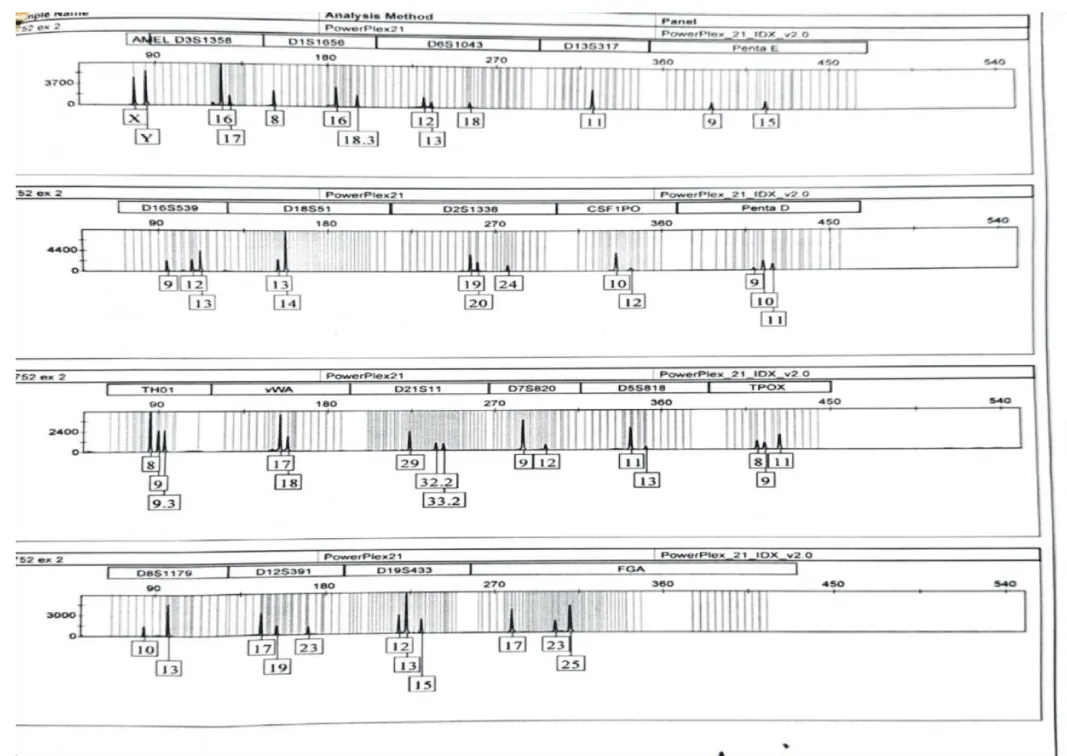
Blood-stained clothes and sanitary pads, along with vaginal swab, cervical may be taken for identification of sperm and DNA profiling thereof. Differential extraction and microscopic examination are the only confirmatory tests for detection of semen in these cases [6]. RT PCR plays an important role in the determination of sex. However, a sanitary pad may also be used to detect spermatozoa if the victim has used such a sanitary pad during menstruation. Menstruation was significantly associated with increased odds of spermatozoa detection [7]. In this study, we have come to conclude that semen was detected in swabs that were collected during assault (Figure 1).
SOURCE OF FUNDING: This work was not funded by any funding organisation. All the samples were analysed in the Forensic Science Laboratory, Rohini, Delhi.
- Lv L. Human menstrual blood: a renewable and sustainable source of stem cells for regenerative medicine. Stem Cell Res Ther. 2018;9. Available from: https://doi.org/10.1186/s13287-018-1067-y
- Li R. Identification of Vaginal Secretions and Menstrual Blood. Boca Raton (FL): CRC Press; 2015.
- Feng Y. The secrets of menstrual blood: emerging frontiers from diagnostic tools to stem cell therapies. Front Cell Dev Biol. 2025. Available from: https://doi.org/10.3389/fcell.2025.1623959
- Kumar N. Deletion of Y-allele in autosomal STR and role of STR. NorCal; 2019. Available from: https://www.semanticscholar.org/paper/Deletion-of-Y-Allele-in-Autosomal-STR-and-Role-of-Kumar-Chauhan/6a81cf29428929f789fda68b6127571176d3a89a
- Tindal K. The composition of menstrual fluid, its application, and recent advances to understand the endometrial environment. Sci Direct. 2024. Available from: https://doi.org/10.1016/j.xfnr.2024.100075
- Butler JM. Forensic DNA Typing: Biology, Technology, and Genetics of STR Markers. Burlington (MA): Academic Press; 2005. Available from: https://catalog.nlm.nih.gov/discovery/fulldisplay/alma9912468843406676/01NLM_INST:01NLM_INST
- Iswara RALW. Association between menstruation and spermatozoa persistence in sexual assault victims: a medicolegal case-control study in Southeast Sulawesi, Indonesia. Sci Direct. 2006. Available from: https://doi.org/10.1016/j.legalmed.2026.102856


 Save to Mendeley
Article Alerts
Subscribe to our articles alerts and stay tuned.
 This work is licensed under a Creative Commons Attribution 4.0 International License.